




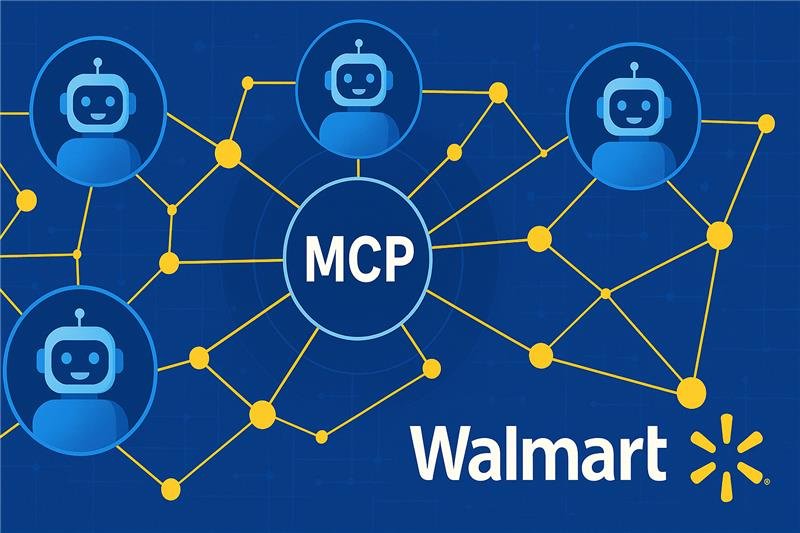
Walmart faced a sprawling landscape of dozens of point-solution chatbots—each handling a narrow task like price checks, inventory lookups, or recipe suggestions. By consolidating these into four unified “Super Agents” (Customer Concierge, Employee Support, Engineering Ops, Supply-Chain Manager) and standardizing on the Model Context Protocol (MCP), Walmart transformed fragmented assistants into collaborative, end-to-end AI systems. This overhaul cut integration boilerplate, improved security, and accelerated feature rollouts—all while powering a more seamless UX for customers and associates alike.
By adopting the Model Context Protocol, Walmart turned each discrete capability into a discoverable, secure tool:
GET /mcp/discover): Each microservice (e.g., priceCheck, inventoryLookup, orderStatus) publishes its schema and parameter definitions.POST /mcp/invoke): Agents call tools with { tool: name, arguments: {...} }; the MCP gateway routes requests to the correct service.Scope : Consolidated \~30 legacy assistants into four Super Agents:
Timeline: “Sparky” launched live this month; “Marty” follows next quarter; the remaining agents will roll out within a year.
Outcomes:
| Benefit | Business Impact |
|---|---|
| Rapid Feature Rollout | +70% faster TTM for new agent capabilities |
| Reduced Maintenance | −80% less integration code per feature |
| Scalable Collaboration | Single orchestration layer for all AI agents |
| Enhanced Security & Compliance | Centralized auth & audit logs across 1.5M users |
Walmart’s shift to MCP-powered Super Agents illustrates how standardizing tool discovery and invocation transforms fragmented AI services into cohesive, secure, and scalable assistants. By unifying dozens of niche bots under a single protocol, Walmart not only streamlined customer and associate experiences but also laid a foundation for rapid innovation—enabling any future AI capability to plug in instantly and securely.